
Can you safely log in and trade on OKX from the US — and what actually happens after you press “Sign in”?
- 发表于 - 2025年4月27日
- By - admin
- 0 评论
What changes behind the scenes when you log into an OKX account, and why does that matter for a US-based trader deciding whether to move capital or execute a leveraged trade? The routine act of signing in is a junction of security engineering, regulatory compliance, and market plumbing. Understanding the mechanisms — from KYC gates to cold-storage custody, and from session tokens to AI-driven threat detection — sharpens the decisions you face: whether to custody keys yourself, how much capital to keep on-exchange, and how to manage the operational risks of high-leverage products.
This explainer will unpack how OKX’s account and login system works in practical terms, compare trade-offs for different user profiles, highlight common misconceptions, and give concrete watch-points for traders in the US who plan to use spot, margin, or derivatives on the platform.
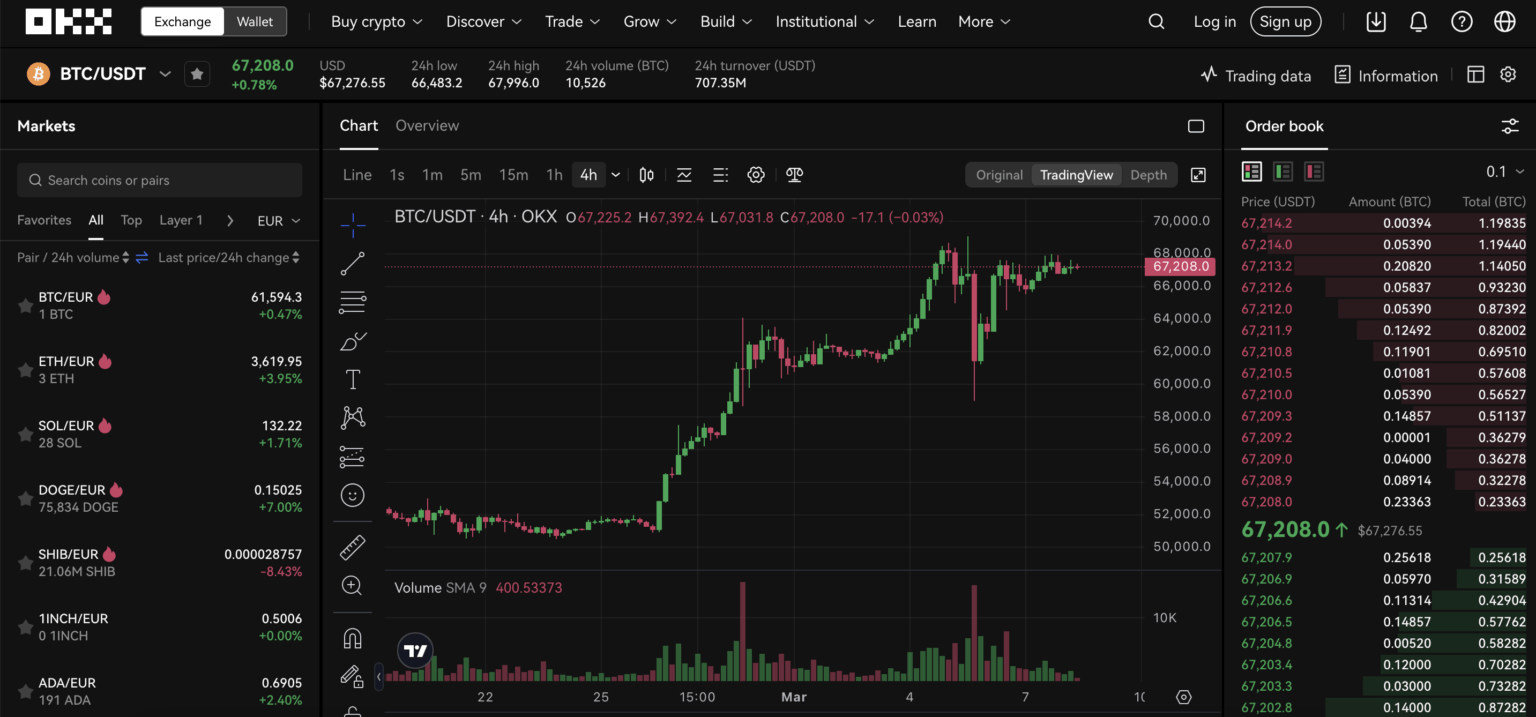
How OKX authentication and account protection actually work
Login at a modern exchange is not “type password, you’re in.” OKX combines several layers: mandatory identity verification (KYC) when opening an account, multi-factor authentication for ongoing access, and platform-level detection that evaluates session risk in real time. Mechanically, you submit a government ID and complete a facial liveness check to satisfy AML rules; the system then issues an account profile that ties your identity to trading permissions and withdrawal limits.
At session time, OKX uses military-grade encryption for credentials, issues time-limited tokens, and requires Two-Factor Authentication (2FA) — either via SMS, Google Authenticator, or biometrics on mobile. The platform monitors login attempts with AI-driven threat models to flag unusual patterns: IP changes, device anomalies, or atypical trade behavior. For US users this matters because suspicious activity can trigger temporary holds while compliance and security teams verify the session, slowing rapid position management during volatile markets.
Where custody, proof-of-reserves, and cold storage fit in
Many traders assume that “assets on the exchange” are always risky. The reality is layered. OKX reports keeping over 95% of user assets in air-gapped cold wallets protected by multi-signature controls — a standard custody practice aimed at reducing large-scale hacking risk. On the other hand, holdings on a live account are still custodial: you rely on the exchange’s operational security and legal structure to access funds.
Proof of Reserves (PoR) adds a transparency layer: OKX provides on-chain evidence that assets backing user deposits exist. PoR is not a panacea — it shows snapshot-backed assets but does not guarantee instant withdrawal ability during stressed conditions, nor does it replace the need to evaluate counterparty, legal, and operational risk. For a US trader, PoR is a useful signal but not a substitute for deciding how much capital to keep on-exchange versus in a self-custodial wallet.
Trading mechanics you meet after login: spot, margin, futures, and DEX access
Once authenticated, the platform exposes tools with very different risk profiles. Spot trading is straightforward: buy or sell at market or limit prices. Margin trading introduces borrowed capital (up to 10x on OKX) and therefore liquidation mechanics: the platform monitors margin ratios and liquidates when maintenance thresholds are breached. Perpetual swaps and options expand the toolset further, with OKX offering up to 125x leverage on some derivatives — a level of amplification that converts small price moves into large gains or losses.
OKX also integrates a DEX aggregator that sources liquidity across protocols like Uniswap and routes swaps. From a logged-in session you can bridge and swap tokens across chains supported by OKX’s multi-chain suite. Mechanically, these swaps may route through multiple liquidity pools; the trade-off is access to better pricing versus added counterparty and smart-contract risk when interacting with DeFi primitives.
Common myths vs. reality for US traders
Myth: “If an exchange keeps most funds in cold storage, my assets are safe forever.” Reality: Cold storage reduces theft risk but does not eliminate operational, legal, or liquidity constraints. In a liquidity crunch or sudden regulatory action, withdrawals can be delayed. For US users, whose accounts are subject to both compliance holds and AML reviews, “safe” includes the probability you can move funds quickly when you need them.
Myth: “Proof of Reserves means absolute solvency.” Reality: PoR demonstrates a 1:1 backing at a point in time but does not reveal off-chain liabilities, pending legal actions, or intraday margin positions that could create short-term withdrawal friction. Treat PoR as a transparency signal, not a guarantee.
Practical trade-offs when deciding how to use an OKX account
If you are a scalper who needs millisecond access and margin capacity, keeping larger balances on-exchange reduces execution risk and ensures immediate margin availability — at the expense of custodial counterparty risk. If you are a longer-term holder preferring control, a non-custodial Web3 wallet (OKX offers one that supports Ledger/Trezor) reduces custodial risk but increases responsibility: lose your seed phrase and recovery is impossible.
Decision heuristic: split capital according to time horizon and function. For example, keep the minimum required for active margin or derivatives trading on-exchange, while larger reserves and long-term holdings remain in self-custody or hardware wallets. Rebalance periodically, and treat the exchange account as a fast-execution instrument, not a permanent vault.
Operational checklist for safe login and trading from the US
Before you log into an OKX account and start trading in the US, check these items: ensure KYC documents are accurate and up-to-date, enable 2FA (prefer an authenticator app or hardware key), register withdrawal whitelist addresses if offered, and link a hardware wallet for large transfers. During volatile markets, consider reducing leverage exposure: high leverage magnifies slippage, gap risk, and the chance of partial fills that can accelerate liquidations.
For an immediate walkthrough of OKX’s web login flow and platform access, see the official page with step-by-step guidance at okx.
Limits, unresolved issues, and what to watch next
Known limits: delistings happen — OKX recently removed several spot pairs (a routine market-maintenance move), which illustrates that low-volume markets you trade may disappear or be de-listed, affecting liquidity and exit paths. Regulation in the US remains a moving target; enforcement and guidance can change KYC/withdrawal policy. DeFi interactions routed through the exchange’s DEX aggregator expose you to smart-contract risk that is distinct from exchange custody risk.
Signals to monitor: changes in US regulatory guidance, OKX’s PoR cadence and audit practices, and any announcements around product availability in the US (some derivatives or tokens can be restricted). Operational signals include repeated AI login blocks or increased withdrawal holds during market stress — those are practical warnings that liquidity or compliance frictions have increased.
FAQ
Do US users have to complete KYC to trade on OKX?
Yes. Account creation requires Know Your Customer verification: submitting a government ID and a facial liveness check. KYC ties permissions and withdrawal limits to your verified identity and is necessary to comply with AML rules.
Is my money safer in OKX’s cold storage than in my own hardware wallet?
They are different kinds of safety. OKX’s cold storage reduces the platform-level hacking risk through multi-signature, air-gapped systems. A hardware wallet keeps private keys entirely in your control, removing exchange counterparty risk but placing total responsibility for recovery on you. The right choice depends on trust preferences and your operational discipline.
What margin and leverage options are available after login?
OKX supports spot, isolated and cross-margin up to 10x for margin trades, and derivatives including perpetuals and options with leverage that can reach up to 125x on specific contracts. Higher leverage increases liquidation risk and requires careful position management.
How quickly can I withdraw funds if markets blow up?
Under normal conditions withdrawals are fast, but during market stress or compliance reviews withdrawals can be delayed. Proof of Reserves shows backing but does not guarantee instant withdrawal during platform- or market-wide disruptions.
Bottom line: logging into OKX starts a chain of security and compliance checks that shape your trading options and speed. For US traders the question isn’t simply “can I log in?” but “what balance, custody mix, and operational habits give me the right mix of speed, security, and regulatory safety?” Treat the exchange as an execution and liquidity layer, not an all-purpose vault, and use the login moment to enforce good security practices rather than to shortcut them.